

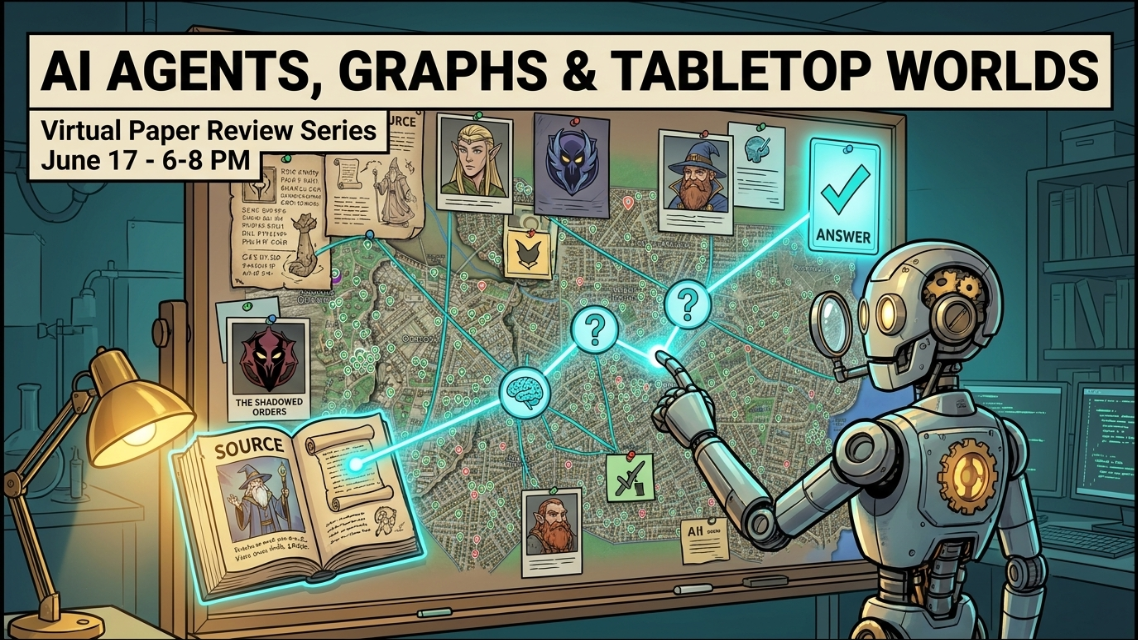
What would it take for an AI to be a useful assistant for a large tabletop campaign simulation? Not just a chatbot that vaguely remembers lore, but a system that knows which NPCs know which secrets, which factions are connected, which rumors came from which source pages, and which claims can actually be checked. That is our entry point for this month’s Virtual Paper Review. We will use a live tabletop campaign-world demo to introduce graph databases, ontologies, and evidence graphs, then connect those ideas to three recent papers on graph-backed AI agents.
Part I – Primer & Foundations
- What graph databases are and why connected data matters
- What an ontology is and why it is more than a schema diagram
- How graph retrieval differs from normal RAG over text chunks
- How evidence paths let an agent show its work instead of just citing something
Part II – Papers & Demo
- SCOUT-RAG: agents walking graph neighborhoods for retrieval
- Why Neighborhoods Matter: the difference between what an agent visited and what it cited
- SHARP: checking graph claims against schema and source-grounded evidence
- Live demo: Tabletop World Simulation
Links:
- SCOUT-RAG: https://arxiv.org/pdf/2602.08400
- Why Neighborhoods Matter: https://arxiv.org/pdf/2605.15109
- SHARP: https://arxiv.org/pdf/2604.04190